




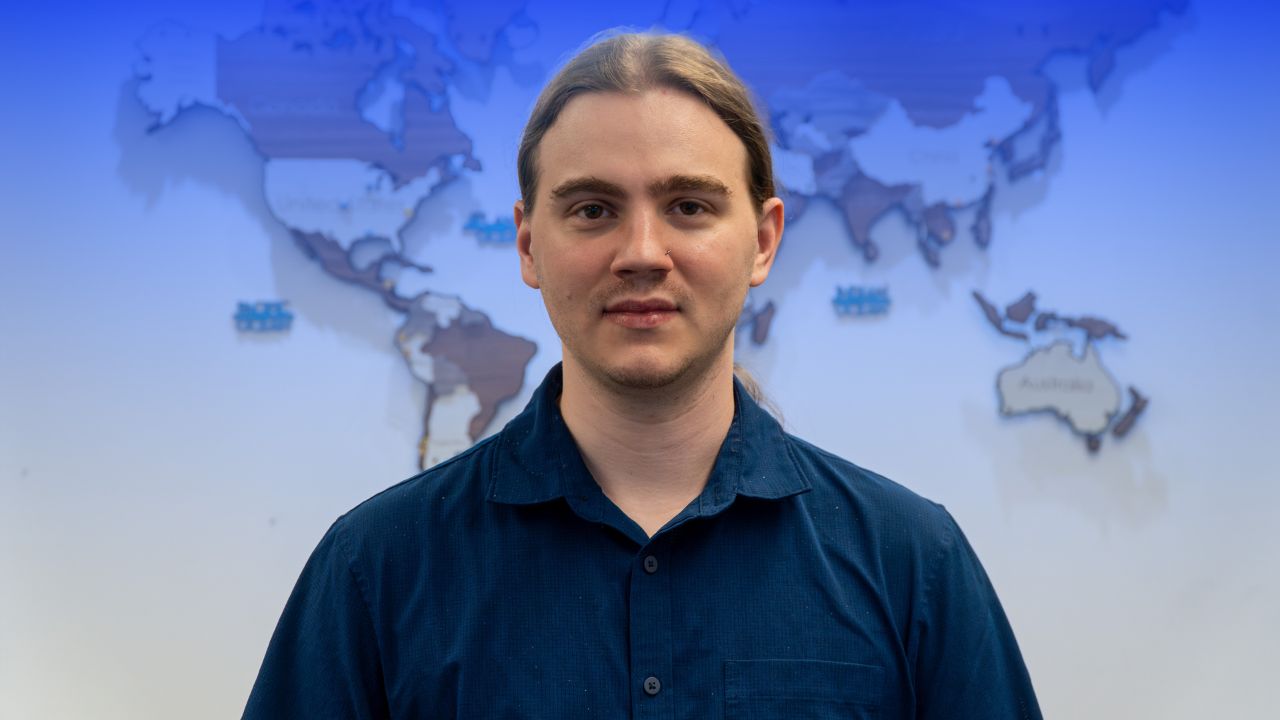
Kyle Bentley's Career Started with an Internship Built by a Fellow Alum
Kyle Bentley grew up in a rural area with limited access to technology but with an early interest in computers. Today, he writes code for a living.
When Kyle was completing his studies at ECPI University, he interned at Terramar USA, an aquaculture raw materials company. The partnership was started by Daniel Grogan, a software developer who is himself an ECPI University alumnus.
As someone who had been in their shoes, Daniel knew what it meant to be a new graduate trying to break into the field. He also knew what ECPI University students were capable of, and he wanted to give them that real-world opportunity.
Kyle turned out to be exactly the kind of student Daniel had in mind. In May 2026, Kyle earned his Bachelor of Science in Software Development, as well as an offer to stay on full-time at Terramar. What started as a program requirement ended up being an unexpected opportunity and the turning point in his career.
What were you doing before you decided to come to ECPI? What drew you specifically to software development?
I was a nuclear reactor operator in the Navy, stationed on the Nimitz. I got out for medical reasons and faced a choice: either I could continue operating nuclear reactors in the civilian world, or I could pursue something I was passionate about.
Growing up, I was always fascinated by computers, and I would tinker with my GameBoy and little gadgets. When I finally got reliable internet access, I was blown away that people could take these chunks of plastic and metal and tell them what to do. That alone felt really magical to me.
When you were considering your options, why did you ultimately choose ECPI?
The main draw for me was time. I could complete my bachelor’s degree in two and a half years, and that mattered a lot. So did the small class sizes.
I’d gone to another university before I was in the Navy, and they had these enormous classrooms full of maybe 100 or 200 people. You didn’t really get that one-on-one time with your instructors. That wasn’t the experience I had at ECPI. The classes were much smaller, so I had opportunities to ask questions if I needed clarification.
How did the internship at Terramar come about? Were you out there applying on job boards?
Actually, the Career Services team at ECPI found Terramar for me. They had two or three different places that they wanted to send me to for my program internship. Terramar was the one that contacted me and decided to bring me on.
There wasn’t a formal application to the process. I did have to come in and do an interview, and I brought a copy of my resume that I worked on with Career Services.
What do you think actually got Terramar’s attention?
Honestly, I feel like it had to do with PHP, which is a language I learned a lot of in my classes. That’s one of the primary languages at Terramar, so I think that when they saw I had that skill on my resume, they knew I was going to be able to slot in very easily and develop on the job.
How quickly did you feel like a contributing member of the team?
I actually had a co-intern with me who also attended ECPI University. The first couple of days were mostly getting set up and meeting everyone. But very quickly after that, we were on computers coding and making something happen.
Our internship coordinator, Daniel, told us he was impressed. He didn’t expect us to produce the things that we produced as quickly as we did, or as well as we did. My experience with PHP was definitely fundamental in how I was able to grasp things.
Looking back, what did the internship give you that you feel you couldn't have gotten any other way?
It completely changed my idea of where opportunities exist. I had a set idea in my mind about what software development was, and I imagined myself in the future working for some giant tech conglomerate. But this experience showed me that opportunities exist in places that you wouldn't expect, and that those opportunities are just as valid and just as important.
I don't feel like I could have gotten such an amazing opportunity if not for this internship program. I was very nervous and very afraid going out into the world after graduating that I would struggle to find a place of employment. Because of the internship, I was offered a full-time position.
Can you talk a bit about that? How did the job offer happen?
That’s a funny story, actually. On my very first interview with Daniel, I told him upfront: I’m not looking for a job here. At the time, I had planned to move back to Ohio to be with my grandparents.
About three or four weeks into the internship, Daniel pulled me aside and said, “Kyle, I noticed that you’re pushing the charge. I can see that you have fire in your eyes, and I can see that you love this. It would be great if you join the team.” And that kind of threw a whole wrench in my plans. I didn’t expect that.
But then I thought it would be pretty foolish to turn down an opportunity that was being presented to me on a silver platter, so I said yes.
How is your new role at Terramar going?
I’m still very early in my role. Right now, my biggest focus and priority is familiarizing myself with the company, how we do business, and what I need to know to make good and solid contributions.
We also have two new interns with us right now from ECPI University. I’m not too involved with them yet. I’ll stop by to chat and ask if they have any questions. But down the line, I’d love to be more involved with future interns.
There's a lot of conversation right now about AI in software development. As someone working in the field, what's your honest take?
I mainly see it as a tool, like a calculator. It helps software developers do things better and more quickly. But we still need that human guidance. I can’t ask AI to do something that I have in my brain and expect it to do it perfectly. It’s helpful, but it has to be used correctly. That’s my honest opinion.
What would you tell a company or employer that's on the fence about bringing on interns?
I would tell them it could be a really good experience. You might find your next great hire. You'll have an opportunity to see what are the skills that are up-and-coming in the job market from recent graduates. You might get new perspectives.
I mean, new technologies are coming out all the time. If you only ever take the perspective of people who are working at your company, then you might not be exposed to those things.
What do you think makes an internship actually worth it for the student?
The biggest thing is getting interns working on something real. Even if it's not something the company will actually use, get them building, get them doing something that's actually in the field.
I've heard stories of people who had internships where that just wasn't the case. At the end of the day, you want them to be able to flex their skills and see how those skills apply in the real world. For us, that was building a training platform. That's what made it worth it.
When the right student meets the right opportunity, it can change the entire trajectory of a career. For Kyle, that opportunity came in a way he didn't expect. But he was ready for it.
Now as a full-time developer doing what he loves, Kyle is already thinking about what comes next, both for himself and for the interns who follow.
The fact that a fellow ECPI University alumnus was the one who saw Kyle's potential and made the call speaks to something special. The cycle Daniel started is already continuing. That's the real power of alumni giving back.
About the Author: Sarah Campo
Sarah Campo is the Director of Alumni Engagement at ECPI University. She is passionate about sharing graduate stories, celebrating their achievements, and building meaningful connections that continue beyond graduation.
