




Why Bridging the AI Digital Divide for Adults Starts with Local Initiatives
Key Takeaways
- An emerging AI digital divide is leaving older adults behind, with 66% of Americans ages 18 to 29 reporting chatbot use compared with 23% of those 65 and older
- Virginia's AI education efforts focus mainly on K-12, leaving adults largely outside the framework
- Local organizations like libraries are well positioned to reach adults but often lack AI expertise
- Colleges can fill that gap through community partnerships, as seen with AI Collective Hampton Roads and ECPI University's session for senior living residents
For decades, efforts to close the digital divide have focused on expanding internet access and helping people develop the skills to use technology. Although progress has been made, disparities persist, particularly among older adults and lower-income communities.
Artificial intelligence is adding another dimension to this challenge. As AI becomes more common in everyday life and the workplace, opportunities to develop the skills needed to use it remain uneven. Students may encounter AI through their schools, while employees may receive guidance from their employers. Others, however, have fewer opportunities to become familiar with the technology.
Virginia has begun addressing AI education through statewide initiatives, though primarily in its K–12 schools. Reaching adults and other underserved populations will require a broader approach, with local organizations and educational institutions helping bring AI education directly into communities.
A New Kind of Digital Divide
Differences in AI adoption point to an emerging AI digital divide. In 2026, 66% of Americans ages 18 to 29 reported having used an AI chatbot, while under half of U.S. adults overall had done the same. Among adults 65 and older, that number is just 23%.
These disparities are becoming more consequential as AI makes its way into familiar digital services. Someone who has never intentionally used a chatbot may still encounter AI-generated information through an online search or another application.
People with limited digital experience may find AI particularly challenging to navigate. Those who are less familiar with evaluating online information may struggle to recognize inaccurate AI responses. They may also have difficulty understanding what information is safe to share with a chatbot.
Digital literacy provides an essential foundation for developing AI skills. Familiarity with technology helps people adapt to new tools, while using AI effectively requires understanding its capabilities and limitations. This becomes especially important when dealing with systems that can produce convincing but incorrect information.
Without opportunities to develop these abilities, existing disparities could become more pronounced and the digital divide even wider.
Virginia's K–12 Approach to AI Education
Virginia's recent legislative efforts have established a framework for introducing artificial intelligence into public education.
In 2026, the Commonwealth enacted legislation requiring the Virginia Department of Education to develop guidance for the safe, ethical, and equitable use of AI in K–12 instruction. It also established the AIS Innovation in Education Pilot Program, which supports schools in exploring AI applications for instruction and student support, with priority given to rural and under-resourced communities.
These measures build on Virginia's broader commitment to digital inclusion. The Commonwealth's Digital Opportunity Plan addresses longstanding barriers to internet access and digital literacy, emphasizing the importance of understanding needs at the community level. Although the plan is not specifically focused on AI, its approach applies just as well to AI education.
Some state investments are already supporting technology education outside traditional classrooms. In Hampton Roads, Virginia allocated $200,000 for RFK Outreach to support equipment for a mobile cyber education bus intended to expand cybersecurity and AI literacy instruction throughout the region.
These investments can help establish the resources needed to expand AI education, but much of Virginia's emerging framework remains centered on K–12 students. Adults who have already completed their formal education are largely absent from this framework, even though many are already encountering AI in their daily lives.
Why Local Organizations Can Lead
The barriers to AI education vary considerably across communities. Unreliable internet access may be a primary concern in some rural areas, while residents elsewhere may have the necessary technology but little experience using it.
Local organizations are well suited to address these differences. Many already have established relationships with residents who may be unlikely to seek out AI education independently. By building on those connections, they can introduce the technology through familiar settings and develop instruction around the needs of their communities.
Public libraries offer one model that communities can adopt. At the Frisco Public Library in Texas, partnerships with local technology professionals have helped strengthen AI literacy for residents. The library draws on volunteers and specialists to support instruction ranging from introductory concepts to practical applications, including career development and planning.
This approach also addresses a challenge facing many community institutions. Libraries may have strong relationships with residents, but they often lack staff with the specialized knowledge needed to teach a technology like AI. Outside professionals can contribute that knowledge while libraries provide the setting and community connections.
How Hampton Roads' AI Collective Is Reaching Communities
In Hampton Roads, community efforts are already underway to help residents learn about AI. Many welcome people with no technical background and focus on making the technology approachable.
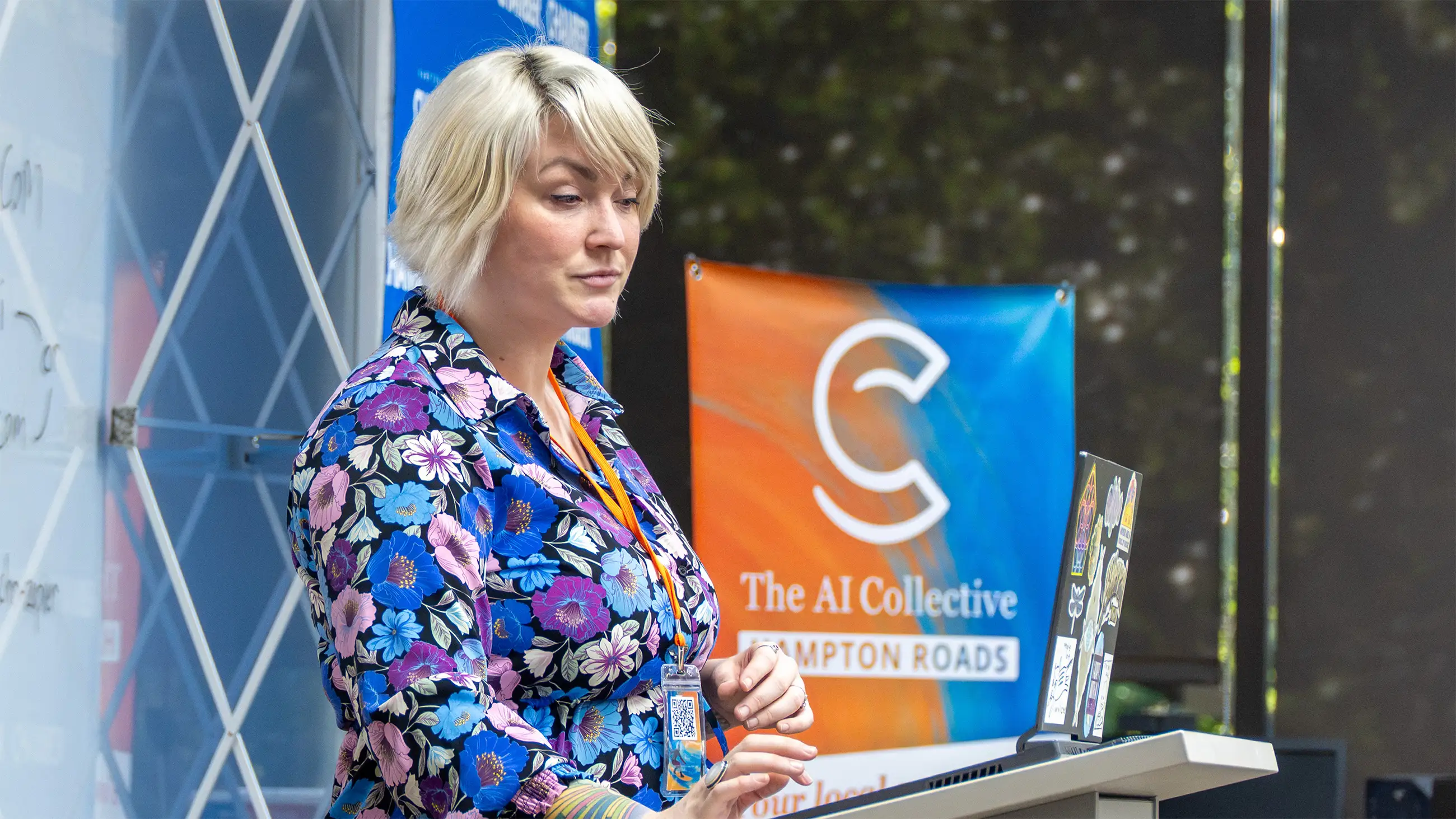
One of these is AI Collective Hampton Roads, the local chapter of The AI Collective, a global nonprofit community. The chapter has more than 7,000 members in the region and, in 2026, has held more than 60 events across Norfolk, Virginia Beach, and the Peninsula, working with local groups as well as global organizations such as OpenAI.
These events include free hands-on workshops, community meetups, and hackathons. Every other week, the chapter also hosts a Build and Demo Night in Virginia Beach and a study group at Christopher Newport University, both open to attendees of all experience levels.
Participants include learners, professionals, entrepreneurs, and other community members, with particular emphasis on upskilling adult learners and reaching underserved and underrepresented communities.
The chapter's next hackathon, The Next Frontier, opens with a beginner-friendly workshop at ECPI University's Virginia Beach campus that requires no coding experience.
By building a network of educators, industry leaders, technologists, and community partners, the Collective aims to help Hampton Roads take an active role in shaping how AI is used in the region.
Higher Education as an Expert Partner
Many community organizations lack the specialized knowledge needed to teach AI, and colleges and universities are in a strong position to help fill that gap. Their faculty and instructional resources can help those organizations introduce the technology to broader audiences.
AI is often treated as a topic primarily for those in technology fields. Yet AI literacy is increasingly relevant to people of all ages and backgrounds.
ECPI University recently welcomed seniors from Commonwealth Senior Living to its Virginia Beach campus for an introductory AI session. The experience gave residents an opportunity to explore the technology and ask questions in an educational setting.
Partnerships with community organizations could bring similar opportunities beyond college campuses. Libraries and senior living communities, for example, could collaborate with nearby faculty to offer instruction tailored to the people they serve.
These relationships can help universities better understand local needs. Older adults may have different questions about AI than people preparing to enter the workforce, and instruction should reflect those differences.
Colleges and universities can also help community partners keep their programs current while emphasizing lasting skills, such as evaluating AI-generated information and recognizing its limitations.
Closing the AI Gap Beyond the Classroom
Virginia's investments in AI education have begun preparing students and educators to engage with the technology. Yet many adults will encounter AI without the benefit of instruction through a school or employer.
Meeting their needs will take a sustained commitment from both higher education and local organizations. Colleges and universities should make community AI literacy an ongoing part of their outreach, providing the instructional resources that local organizations need to reach residents who might otherwise be overlooked.
The Commonwealth's progress in AI education will depend in part on extending these opportunities into communities. Doing so can help more people develop the understanding needed to participate, regardless of their age or educational background.
About the Author: Erin Marie
Erin Marie is an Applied AI Strategist at ECPI University, where she leads efforts to bring AI into the classroom and across the organization. She is also co-founder of AI Collective Hampton Roads. Her work focuses on bridging technical and non-technical perspectives and helping people engage with AI in practical, human ways.
