




How Lifelong Learning Prepares You for a World That Keeps Changing
Key Takeaways
Lifelong learning extends far beyond traditional classroom instruction through community involvement, clubs, competitions, and professional development. Students and professionals can continuously expand skills and knowledge through diverse learning opportunities.
- Engagement in student clubs, organizations, and eSports provides practical skill development
- Community partnerships create real-world learning experiences outside formal coursework
- Professional certifications and specialized training supplement degree programs
- Continuous learning supports career advancement and industry relevance
Education is often discussed in terms of preparation. Throughout the K–12 period, students prepare for advancement to the next grade and, eventually, to enter college, trade school, or another chosen path. From there, they continue to prepare for careers, for credentials, and for the expectations that come with professional life.
Viewed through this lens, education becomes something whose success is measurable. That success can be defined through straightforward questions: Are students adequately equipped for their professional lives? Can they effectively perform the tasks that are required of them? While this framing seems narrow, it does give education a clear and practical sense of purpose.
Yet this kind of preparation only represents one part of what education provides. It also prepares people in less concrete ways. It influences how they respond to unfamiliar ideas, how they adapt to changing environments, and ultimately how they interact with the world around them.
Seen this way, education extends beyond the classroom and beyond any single stage of life. It becomes a means of staying engaged with the present rather than focusing on a single moment in the future. In doing so, education takes on an ongoing sense of purpose.
Preparing for a World That Keeps Changing
The goal of any educator is to ensure that students have the knowledge and skills to step outside the classroom, to fly from the nest. Once they leave that environment and venture into the wider world, they are expected to chart their own paths.
But even when students are well-prepared for life after formal instruction, one clear challenge remains: How can educators fully prepare students for a world that is constantly changing?
This question has become more relevant than ever. While subjects like history and foundational mathematics tend to revolve around relatively stable knowledge, other fields see great changes happening over a short period of time. This is especially evident in technology, where the pace of change is not only rapid but increasingly becoming faster.
Artificial intelligence, in particular, has shown the extent of this. In November 2022, OpenAI introduced ChatGPT to the world. Though AI had long been a topic of discussion, this moment marked its wide reach. Since then, AI has become part of both public discourse and everyday life. In a matter of three short years, it has reshaped whole industries and redefined the professional skills that workers require.
As a result, educational institutions have had to adapt. After all, if AI is now an inextricable part of life, an education that excludes it risks leaving students unprepared for what they will invariably encounter.
But AI is only one part of this conversation. Other emerging technologies and fields will continue to affect life and learning in ways that are hard to predict. That much is clear. If change itself is a constant, what needs to be re-examined is the approach to education. Rather than being responsive, it must be adaptive.
How Participation Gives Way to Lifelong Learning
If education cannot fully anticipate the conditions students will face in the years ahead of them, it can still prepare them to engage with these conditions as they arise. This kind of preparation emphasizes how students learn rather than what they learn. Instead of merely mastering the content, they develop the skills to navigate unfamiliar situations.
By building these skills, students leave the classroom ready to become active participants in the world around them. They are equipped to ask questions, evaluate information, and adapt to evolving circumstances. In this way, formal education may come to an end, but learning itself never does.
For many people, these habits don’t simply disappear once a degree is earned or a career is established. Their curiosity remains as the world keeps inviting them to participate in it. This participation may be less easily measured, but it is far more dynamic and enduring.
However, as with any habit, it requires consistent practice to keep it going. This effort gives new meaning and new purpose to education. More than being tied to the classroom or to any one goal, it becomes a lifelong pursuit.
What Lifelong Learning Looks Like in Practice
There are many stories which serve as reminders that education continues to shape people’s lives at different stages. For some, it means beginning their journey later in life. For others, it involves rediscovering a sense of purpose. Regardless of the story, a familiar lesson always emerges: education is never fully out of reach.
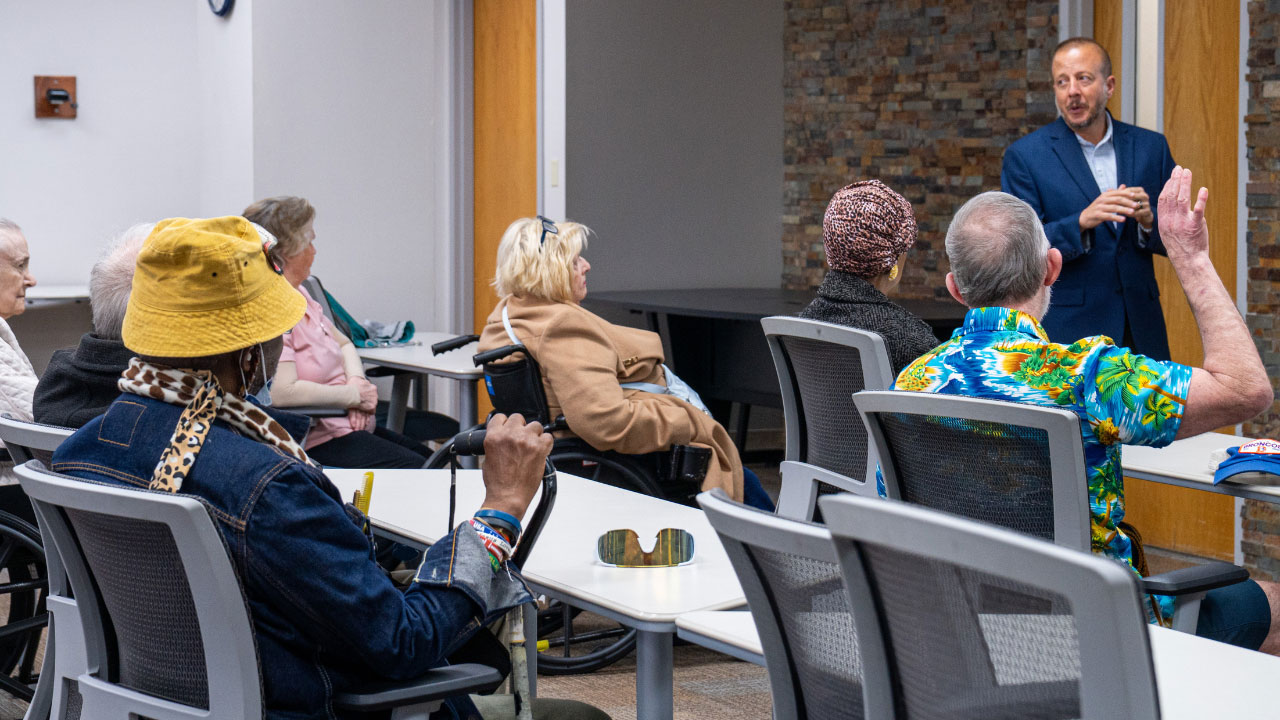
Last week, ECPI University hosted a group of residents from Commonwealth Senior Living at Churchland House as part of their ongoing learning initiative. Known as Silver University, the program provides residents opportunities to explore their interests and curiosities through curated local experiences, such as visits to historical sites and lectures from guest speakers.
The group’s visit to ECPI University marked the first time they took their learning to a higher education setting. It carried additional significance, as multiple residents were former educators themselves.
Organized by Chad Clem, a frequent guest lecturer for the CSL program, the visit included a campus tour, featuring the crime scene lab, the Maker’s Space, and the library. The group also participated in an introductory lesson on AI, which included a live demonstration of Fixit, the robot dog.
The lesson was led by Gerry White, ECPI University’s Dean of Academic Technology. For White, the purpose behind the session centered on accessibility and respect: “Too often, conversations about AI are framed for the young, the technical, or those already immersed in emerging technology.”
Discussions about how AI is reshaping the workplace are increasingly common, but that doesn’t make AI itself an irrelevant topic to retired seniors. AI now affects everything from cell phones and web pages to household appliances. Despite being out of the workplace, seniors continue to interact with technology as part of their lives. As such, being a part of that conversation remains relevant and necessary.
For the residents, the experience proved to be both positive and memorable. One resident, Diane, exclaimed, “I really liked the shooting lab and the zombies! I didn’t expect that!” Another resident, Wilman, shared, “I loved it all. The robot dog was marvelous!” And Mrs. Rosa, a retired school principal, remarked, “I loved learning about the history of the university and how they maintain their goals and support of the military.”
Ultimately, the visit underscored the importance of remaining active participants in education. Learning is driven by curiosity and necessity, not by age or circumstance.
All the World’s a Classroom
It is, of course, important to ensure that students are equipped for whatever next steps they take in their lives, whether that means career readiness or another path entirely. While it can be easy to evaluate education in stages, most moments of learning don’t label themselves as major milestones. Instead, they appear quietly and take shape through an individual’s daily participation.
This is what gives real meaning to education. Success, in this case, isn’t defined by something measurable like progression or completion, but by continuity. The role of a student doesn’t end once the classroom is left behind. It simply evolves.
By approaching education from this perspective, it becomes possible to remain connected to a world that continues to change. In many ways, this ever-going pursuit of learning is not only noble but necessary.
