




What "Soft Skills" Can Say About Who Succeeds in Healthcare
Most healthcare training focuses on procedures and protocols, but that's not all that separates the people who thrive from the people who struggle.
ECPI University explores a much-overlooked quality in a new article in the latest edition of Career Education Review, the quarterly magazine published by Career Education Colleges and Universities (CECU), a national association that represents career-focused schools and the students they serve.
The piece, Why "Soft Skills" Drive Hard Outcomes in Healthcare, looks at why communication and judgment matter as much as clinical skill, and how healthcare programs can teach them on purpose.
Why do soft skills matter so much in healthcare?
Healthcare workers rarely do their jobs alone. They work in teams and spend their days with patients, so being able to communicate clearly and make good decisions is part of the job itself. Research has long shown that communication, judgment, and working well with others account for most of a person's job performance.
In healthcare, the stakes are higher than in most fields. Professionals often make quick decisions in high-pressure moments, and when communication breaks down, the result can be missed details or avoidable mistakes. Stronger communication and judgment are tied to better patient outcomes and fewer errors.
Nursing shows this clearly. A nurse who can't explain a care plan or think clearly under pressure will fall short in ways a licensing exam never measures. These abilities are central to the work, and healthcare education hasn't always treated them that way.
How does ECPI University teach these skills?
Soft skills can be taught. They develop through practice, feedback, and repeated exposure to conditions that feel like the real thing, so ECPI University builds that experience right into its healthcare programs.
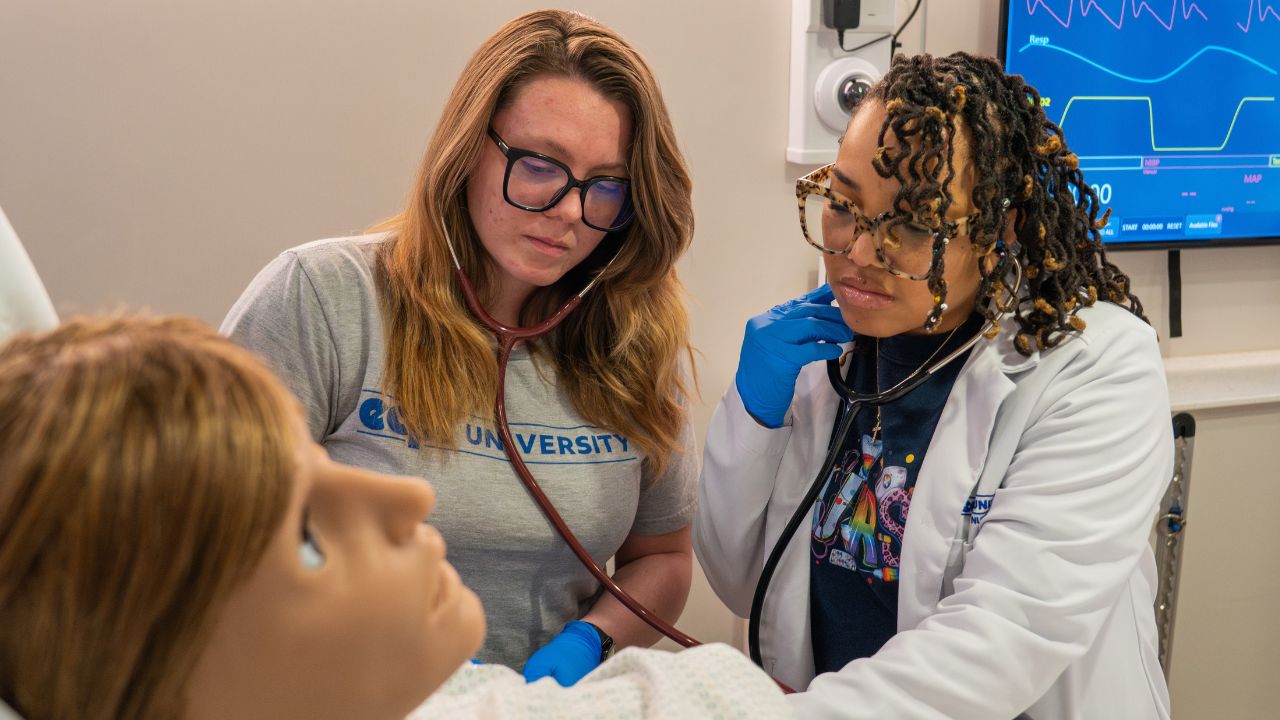
One method is simulation-based training, where students work through realistic scenarios with real pressure and immediate feedback. This happens in a safe space where students are free to make errors and strengthen their responses. ECPI University extends this hands-on approach beyond campus with its Mobile Simulation Lab, an RV outfitted with adult and infant patient simulators that brings clinical practice to students in areas without easy access to a nursing lab.
Another method is the cohort model, where students move through a program together as a steady group. Working with the same people week after week builds the habits of clear communication and shared accountability that every good care team relies on. Those connections often outlast the program itself, and students who already know how to work as part of a team are better prepared to contribute once they enter a real care environment.