




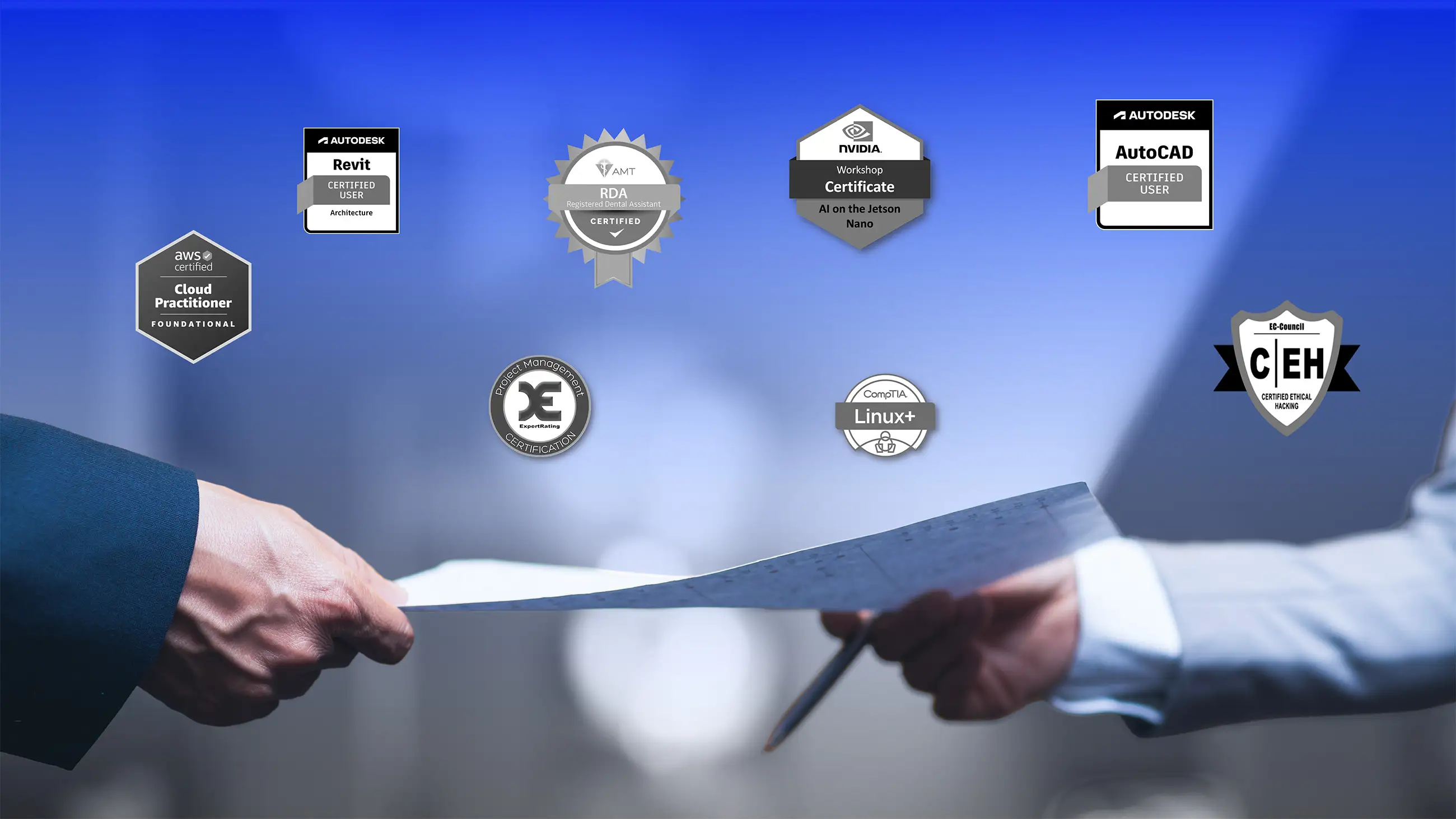
What Are the Best Tech Certifications to Get? We Asked Four Experts
Key Takeaways
- Cybersecurity knowledge is relevant across multiple IT disciplines, and certain government-related positions may require recognized security credentials.
- Entry-level certifications can provide a starting point for developing technical skills, with more advanced credentials offering opportunities to demonstrate additional proficiency.
- Certifications in programming, engineering design, and artificial intelligence can help demonstrate familiarity with tools used in different professional environments.
- Practical experience remains important alongside certification, whether gained through coursework, projects, or hands-on training.
- Academic guidance, study resources, and practice exams can help students identify suitable credentials and prepare for certification testing.
With so many certifications available in technology fields from cybersecurity and programming to engineering design and artificial intelligence, deciding which ones are worth pursuing isn't always straightforward.
We asked four members of ECPI University's faculty and instructional staff which technology certifications they recommend and why. Their answers offer practical perspectives on credentials that can complement hands-on experience and support different career interests.
CompTIA Security+: A Starting Point for Cybersecurity and IT
Cybersecurity knowledge is valuable across the technology industry, even in roles that aren't primarily focused on security. Understanding how to protect digital systems has become an important part of working in IT.
This broad application is one reason Scott Gibson, Program Director for Computer and Information Science, recommends CompTIA Security+.
"It's the gateway to all the jobs in cybersecurity, network engineering, systems administration, software," Gibson says. Security+ covers foundational concepts such as identifying threats, managing risks, and responding to incidents.
The credential can be particularly valuable for those interested in government-related employment. "If you work in a state that has a very high concentration of state [and] federal government jobs, Security+ is required," Gibson explains. Requirements can vary by position, but the certification is recognized for certain government-related IT roles.
Gibson also highlights how students can prepare for Security+ through coursework at ECPI University. "We have a three-course series that specializes and focuses on the Security+ certification. By the end of the last class, you will take the certification during class."
Python Certifications: Building Skills for Software Development
Python is widely used in software development, from building applications to automating repetitive tasks. Its versatility makes it useful across technical roles, including areas such as data analysis.
Mike Jensen, a Software Development faculty member at ECPI University, sees another advantage in Python's widespread recognition. "Python is going to be the most recognizable [certification] from a resume perspective," he says.
For students who are just beginning to learn programming, certification offers a way to demonstrate familiarity with fundamental concepts. More advanced credentials can build on that knowledge as students gain experience writing and troubleshooting code.
Jensen suggests approaching those credentials in stages. "I usually recommend to our software development students to go after the entry-level Python certification first and then followed by the associate level."
He also points to the preparation support available at ECPI University. "Our Certification Hub gives them resources to not only study for the material but test themselves with practice tests," Jensen says, adding that students can also receive a voucher to take the official certification examination.
Autodesk Inventor: Developing Versatility in Engineering Technology
Much of today's mechanical design work begins on a computer. Before a component reaches production, engineering professionals can use computer-aided design (CAD) software to create detailed models and refine how individual parts fit together.
Wyatt Bramel, a Lab and Teaching Assistant, recommends developing proficiency with these tools. "In the Mechanical Engineering Technology (MET) field, it is very advantageous for students to obtain CAD certifications," he says.
Among his preferred credentials is the Autodesk Inventor Certified User. This certification focuses on proficiency with design software used in mechanical engineering, while related computer-aided manufacturing (CAM) experience helps students understand how digital designs connect with production.
Bramel also encourages students to take advantage of the guidance available at ECPI University. "When you want to explore your options and look at getting certifications, it is important that you get in contact with your academic advisor and the dean of whatever program you're in."
NVIDIA AI and Lean Six Sigma: Expanding Your Technical Skills
As artificial intelligence becomes more common across technology disciplines, knowing how to work with AI tools can be a valuable skill for students entering the field.
Karl Kiesler, a Lab and Teaching Assistant, sees value in certifications that demonstrate hands-on experience with emerging technologies. "Several of the AI certs we have offered through NVIDIA would be a huge benefit to be able to show that you've worked with AI models," Kiesler says.
Students can explore these opportunities through ECPI University's student resource hub, which offers NVIDIA-related training led by a certified instructor. According to Kiesler, workshops are held throughout the year.
Beyond AI, Kiesler points to Lean Six Sigma, a methodology focused on improving processes and reducing inefficiencies. He sees it as a useful foundation for students interested in eventually pursuing project management credentials or leadership roles.
"That way, you can eventually push for the Project Management Professional certification," Kiesler says. "Everyone wants that PMP for when they get their master's."
Choosing a Technology Certification That Fits Your Goals
The value of a technology certification depends on how closely it aligns with your interests and the work you want to pursue. Before choosing one, consider these areas:
- Your career interests: Does the credential relate to the responsibilities of your intended field?
- Your experience level: Does the certification match your current knowledge and experience, or would you benefit from additional preparation?
- The abilities you'll develop: What tools and technical competencies does the certification cover?
- Available preparation resources: What coursework, practice exams, or hands-on training can help you get ready?
Industry certifications can provide evidence of technical knowledge, particularly when supported by real-world experience. Choosing one that fits your goals can help you focus your learning and identify what to work toward next.
Prepare for Industry Certifications at ECPI University
ECPI University helps students pursue industry-recognized certifications through career-focused coursework and a dedicated Certification Hub. Students can access study materials, practice exams, and academic guidance, along with subsidized exam costs for eligible students. Many technology courses also come with integrated certification preparation.
Whether you're interested in cybersecurity, software development, engineering technology, or AI, ECPI University provides the resources to help you build and demonstrate skills relevant to your career goals.
