




How Local Action Can Alleviate the National Healthcare Problem
Key Takeaways
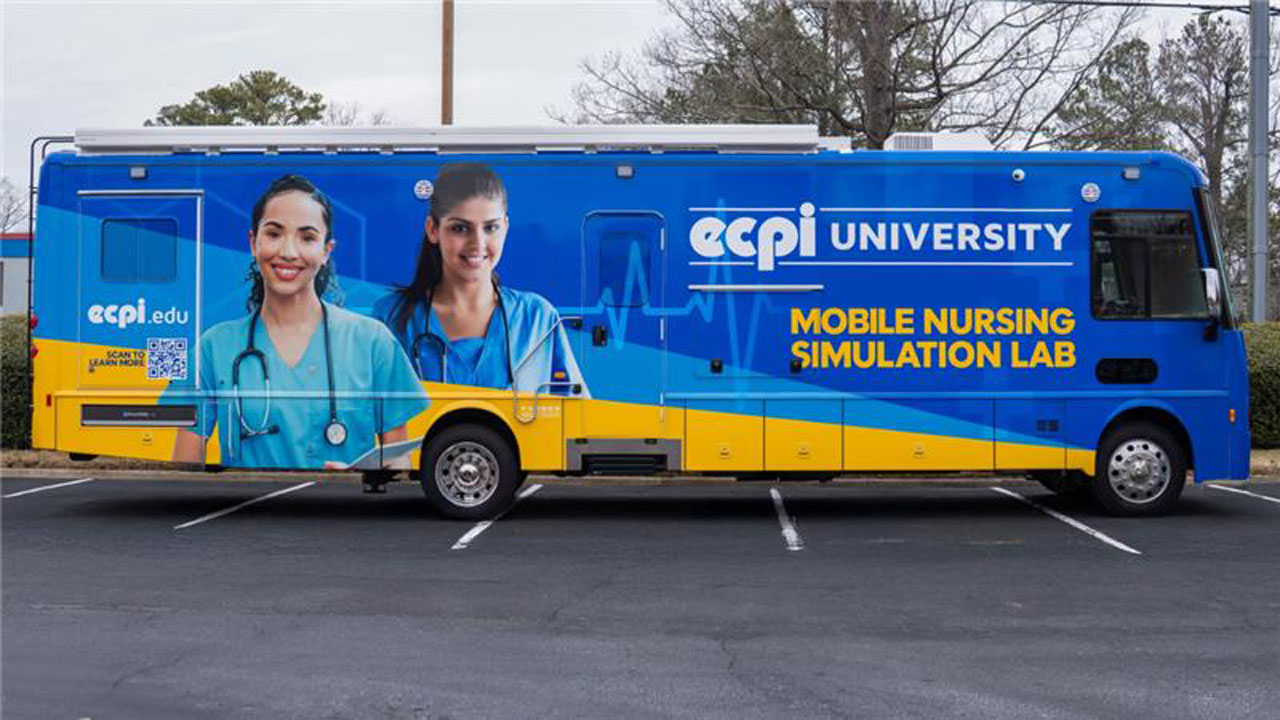
ECPI University addresses the critical healthcare workforce shortage through innovative mobile simulation labs that bring nursing education directly to high schools and communities. These mobile units feature advanced simulation technology and allow prospective students to experience realistic nursing training environments.
- Mobile simulation labs are transported to high schools for community outreach and recruitment of future nursing students
- Advanced simulation mannequins provide realistic training experiences that prepare students for clinical practice
- Mobile labs reduce barriers to nursing education by bringing training opportunities to underserved communities
- Simulation-based education addresses the persistent nursing shortage in Hampton Roads and surrounding areas
- Prospective students can observe nursing training technology and learning environments through interactive mobile lab visits
Across the country, communities are beginning to feel the real consequences of a growing healthcare workforce shortage. Long past being a warning, it now reflects an alarming reality, as staffing pressures continue to affect daily operations and access to care.
While the issue is often discussed on a national scale, it’s important to recognize that its consequences don’t unfold evenly. Across the country, communities experience the effects of these workforce gaps in markedly different ways. This uneven impact highlights the need for responses that operate at both the national level and within local communities.
At the community level, the capacity to develop and sustain a healthcare workforce is influenced by several factors. One of the most fundamental is access to the education and training that is required to prepare new professionals. Where such pathways are limited, building a sustainable workforce becomes more difficult.
How National Trends Translate Into Local Risks
National healthcare workforce figures can often obscure regional maldistribution. On the surface, the issue may appear to be uniform, suggesting that shortages exist everywhere. In reality, some states experience a shortage while others have a surplus. This contrast, however, underscores several important considerations.
First is the recognition that even as surpluses exist, they don’t resolve deficits elsewhere, and they don’t indicate that an area is stable. Projections show that by 2037, the level of healthcare demand met will decrease in every state. Thus, even regions with surpluses may end up with shortages. The issue, therefore, remains one that demands national attention.
When these workforce challenges are left unaddressed, they can lead to severe consequences. In some areas, prolonged shortages have contributed to the emergence of medical deserts. Although the term is inconsistently defined, such areas are generally characterized by features such as limited access to healthcare providers and long travel times to receive care. Rural communities, in particular, face an elevated risk of turning into medical deserts.
Their emergence is rarely abrupt. Instead, they tend to develop gradually as conditions worsen, serving as cautionary indicators rather than isolated anomalies. At the same time, another form of desert poses a growing threat to the stability of the healthcare system.
When Education Access Limits Workforce Development
To meet the increasing demand for care, there must be an adequate supply of both new healthcare facilities and trained professionals. Yet across the country, access to healthcare education and training are also unevenly distributed.
In some regions, students pursuing healthcare careers face significant barriers. Many lack access to local accredited training programs, while others must travel long distances to attend classes. These circumstances are reminiscent of the challenges seen in medical deserts. For that reason, such areas are often described as school deserts.
Like medical deserts, school deserts are not sudden appearances. Rural communities and underserved communities are often hit the hardest, as schools and training programs are concentrated in urban areas. This concentration limits local pathways into healthcare careers and makes it more difficult for communities to develop their own workforce.
What becomes clear, then, is that access to care and access to healthcare education are not two unrelated challenges. Oftentimes, the conditions, patterns, and consequences overlap. As a result, efforts to address one can help alleviate the other.
The Hampton Roads Reality
At the state level, Virginia reflects many of the same pressures shaping the national healthcare workforce landscape. More than 100 localities across the Commonwealth are designated as Health Professional Shortage Areas (HPSAs) in primary care, accounting for roughly 29 percent of the population.
Although state policies have been implemented as a countermeasure, workforce constraints persist. Projections suggest that by 2038, shortages will remain across several healthcare professions, including physicians, registered nurses, and licensed practical nurses.
Within the Hampton Roads region, these pressures are particularly visible. The Health Resources and Services Administration (HRSA) designates communities with an Index of Medical Underservice (IMU) score below 62 as Medically Underserved Areas or Populations (MUA/Ps). Nearly every community in Hampton Roads meets this criterion, with scores ranging from 42.9 to 60.8.
It is important to recognize, however, that these indicators function as early signals rather than definitive outcomes. Because medical deserts are gradual, timely detection and response are important. The current situation is therefore not irreversible, but it does require sustained effort and attention.
Ultimately, achieving workforce stability depends in part on the ability to educate and train new professionals close to where care is needed and delivered. Expanding access to healthcare education has become a key focus of local response efforts, and Hampton Roads is no exception.
How ECPI University is Taking Nursing Education on the Road
Workforce challenges in healthcare affect members across the multidisciplinary team. Level of access to education and hands-on training can have a significant impact on direct patient care. Expanding where and how healthcare education can be delivered is crucial to meet growing demands.
ECPI University has taken a targeted approach through its Mobile Nursing Simulation Lab, a high-fidelity training environment that is designed to bring clinical education directly into local communities. This resource is a powerful tool that will allow students and faculty to engage with their communities in a meaningful way.
Inside the unit, learners train with tools designed to replicate real clinical settings. This space is outfitted with high fidelity simulators including a Pediatric Hal, Susie S2400, and Newborn Tory. These manikins allow for provision of education across the lifespan.
Task trainers are available for learners to practice popular skills such as IV insertion and maintenance, wound care, oxygenation and airway management, and medication administration. The space can be configured to meet needs as they arise, which will allow educators to uphold the ever-changing expectations of best practice.
ECPI students will have the opportunity to gain experience in community health by participating in health fairs and screening programs. Local healthcare organizations are encouraged to book the Mobile Unit to provide hands-on training to their staff. This will help to bridge educational gaps in the clinical setting. With equipment to immerse the learners during each experience, including a control room and video monitoring, the Mobile Unit helps bring simulation to life.
Though not a comprehensive solution to the national workforce challenge, this response illustrates how community partnerships can play a meaningful role in addressing specific local barriers. Over time, these localized efforts can contribute to greater workforce stability and preparedness.
Moving Toward a Coordinated Response
Addressing the healthcare workforce shortage will require sustained attention at both the national and local levels. While national data and projections can help define the scope of the issue, it’s within the local communities where these gaps in care and education are directly felt.
Expanding access to healthcare education is therefore a critical part of any effective response. When training opportunities are available closer to where care is needed, communities are better prepared and better positioned to address the issues that affect them most.
Certainly, no single initiative can resolve a challenge of this scale and magnitude. However, aligning national priorities with local efforts can offer a better and more durable path forward.
