




Learning on the Line: ECPI University’s Partnership with Volvo Cars USA
Key Takeaways
ECPI University partners with Volvo Cars USA's Charleston manufacturing facility through a U.S. Department of Labor Registered Apprenticeship program that bridges a critical skills gap for technicians needing both mechanical and electrical systems expertise. Four cohorts have completed the program successfully with two more in progress and additional cohorts launching.
- Volvo's Charleston facility identified critical shortage of technicians skilled in combined mechanical and electrical systems
- Faculty map courses directly to Volvo equipment and operational needs for hands-on relevance
- Apprenticeship model combines structured on-the-job training with academic instruction
- Program addresses manufacturing skills shortage at the nation's first North American Volvo plant
- Expanding enrollment demonstrates strong industry demand and program effectiveness
On a typical evening after finishing his shift at the Volvo Cars USA plant, Brian Spinney would make his way to ECPI University’s Charleston campus. It had been more than 20 years since Brian last sat in a classroom.
He was used to reading from textbooks and taking notes by hand. Now, he was staring at a laptop screen while trying to figure out the keys. It was a new world Brian found himself in, but he knew he had to adapt quickly.
Over time, he noticed that the adjustments he was making in the classroom were not all that dissimilar to the changes he was seeing at the plant. The equipment around him was growing more complex, and the work itself was no longer purely mechanical. It increasingly demanded a wider array of skills and a deeper understanding of everything on the floor.
What Brian was navigating wasn’t unique, however. Across the industrial landscape, workers with years of experience are encountering similar shifts and demands as technology reshapes their roles. This is especially evident in modern advanced manufacturing.
An Industry in Need
Across the country, manufacturing, like many industries, is facing concerning labor shortages. More than half a million manufacturing jobs are currently unfilled, and if this issue is left unaddressed, that number is expected to exceed two million by the turn of the decade.
Moreover, in an industry where the average worker is 44 years old, the so-called silver tsunami is threatening to make waves. As the aging workforce nears retirement, there are not enough new hires ready to step into those roles.
Despite this urgency, another challenge compounds the problem: there isn’t sufficient talent to meet the needs of modern manufacturing. All of this comes at a time when public demand for American-made goods is increasing.
At the current pace, it's clear that replacing retiring workers alone will not be enough. Rather, employers must find ways to support both new and existing workers as they adapt to rapidly changing roles.
One of the ways ECPI University is addressing this issue is through its employer-educator apprenticeship programs.
The Volvo Cars USA-ECPI University Partnership
In 2018, Volvo Cars USA opened its first North American manufacturing plant in Charleston, South Carolina. As the facility expanded its production, the company quickly realized that it faced a critical skills gap among technicians capable of working with both mechanical and electrical systems.
Rather than competing for outside talent in an already constrained global market, Volvo Cars USA instead decided to grow its own talent. To that end, the company identified existing employees with strong technical aptitude and high potential and invested in training them for more specialized roles.
This effort led to the creation of the Department of Labor-certified Multi-Craft Technician Apprenticeship Program.
How the Partnership Began
In 2021, as Volvo Cars USA continued to refine its apprenticeship model, the company sought a partner that could align more closely with its operational pace and workforce needs. That search led to ECPI University.
Rather than asking Volvo Cars USA to adapt to a rigid academic structure, ECPI University worked alongside the company to design a program that fit its production environment.
Though originally structured as a three-year pathway, ECPI University was able to streamline the model into a two-year program by tightening course sequencing and minimizing downtime between terms. Given the nature of manufacturing, that acceleration was a crucial improvement.
Volvo Cars USA employees now take classes at ECPI University’s Charleston campus, where they are integrated into the campus learning environment. As with all students, they have access to academic resources such as tutoring, library services, and lab space.
A Program Built for the Job
One of the most significant components of the program is that it also allows for a more customized and aligned curriculum. ECPI University’s faculty and staff work directly with Volvo Cars USA’s maintenance team to map courses to specific skills and equipment.
As a U.S. Department of Labor Registered Apprenticeship, the program combines academic instruction with structured on-the-job training. In addition to their regular responsibilities at the plant, apprentices receive practical workplace training under the guidance of a dedicated one-to-one mentor.
At ECPI University, apprentices take one class at a time, which helps make the rigorous experience more manageable. They also move through the program as a cohort, providing additional structure and peer support. Volvo Cars USA periodically invites employees from other manufacturers to participate in its ECPI University apprenticeship cohorts.
Through this partnership, four cohorts have completed the program to great success. Two more cohorts are actively undergoing their training, and additional cohorts are set to start later this year.
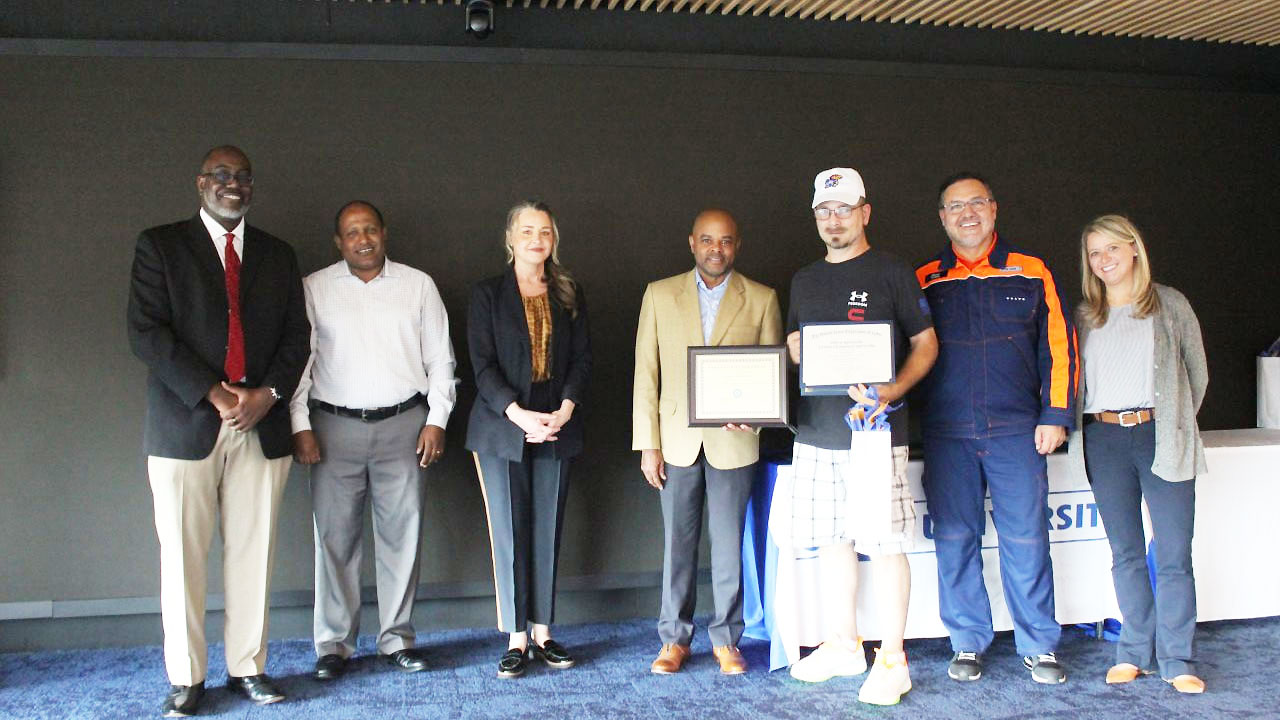
The most recent group to complete their training included six apprentices who collectively achieved a GPA of 94, the highest to date. Among this cohort was Brian Spinney.
Perspectives from an Apprentice
When Brian Spinney was selected for the apprenticeship program from a pool of approximately 60 applicants following a series of tests and interviews, he felt elated. At the same time, he was fully aware of the commitment ahead.
Early on, Brian recognized the importance of managing his time. As a returning adult learner, he knew that he would have to devote some extra attention to strengthening his digital skills to keep up with the learning pace.
As the program progressed, Brian found himself spending between 10 to 16 hours per week on coursework. It took time to establish a rhythm that worked for him, but through consistent efforts, he always stayed on track.
Brian recounted that part of his success was due to the ECPI University's instructors and staff, many of whom were industry professionals themselves. He remembered Ronald Neil, Getachew Abey, Praveen Nalla, and Ed Smalls as tireless beacons of support throughout the experience.
For Brian, one defining aspect of the apprenticeship was the ability to apply new knowledge directly on the factory floor. He reported using skills he gained in the classroom in HVAC, PLCs, and pneumatics, which continue to serve him on a daily basis.
Since completing the program, Brian has stepped into his new role as a maintenance technician at the plant, supporting a range of industrial equipment and systems. Due to his technical proficiency, Brian is now regularly called to troubleshoot issues on his own.
A Model for Sustainable Workforce Growth
For employers facing rapid technological and workforce shifts, investing in employee development is a strategic decision. But for those investments to succeed, they must reflect the unique realities employers face.
At ECPI University, the student-first approach emphasizes responsive program structures, streamlined processes, and flexible scheduling. Those same principles allow the university to build apprenticeship models that meet employers' needs.
While not a one-size-fits-all solution to labor shortages, ECPI University’s partnership with Volvo Cars USA demonstrates how carefully designed employer–educator collaborations can help expand workforce capacity in an efficient and effective manner.
This creative model isn’t limited to manufacturing. The same approach can be adapted across nearly any industry where employers are looking to upskill their teams for evolving technical roles with flexible schedules, content, and modalities.
In an environment where change is the only constant, the employers best prepared for the future are those who recognize workforce development as an essential part of their business.
About the Author: Kristie Cumbee
With ECPI University for 18 years, Kristie Cumbee currently serves as the University Director of Workforce Development. Kristie brings over thirty years of experience in workforce development, human resources, and organizational leadership to her mission of delivering the most efficient, effective solutions to skills gaps in our communities.
